Use capacity only for a shortlist
The Fit Finder accepts common capacities such as 120L, 140L, 180L, 240L and 360L. Exact measurements are still the more reliable input.
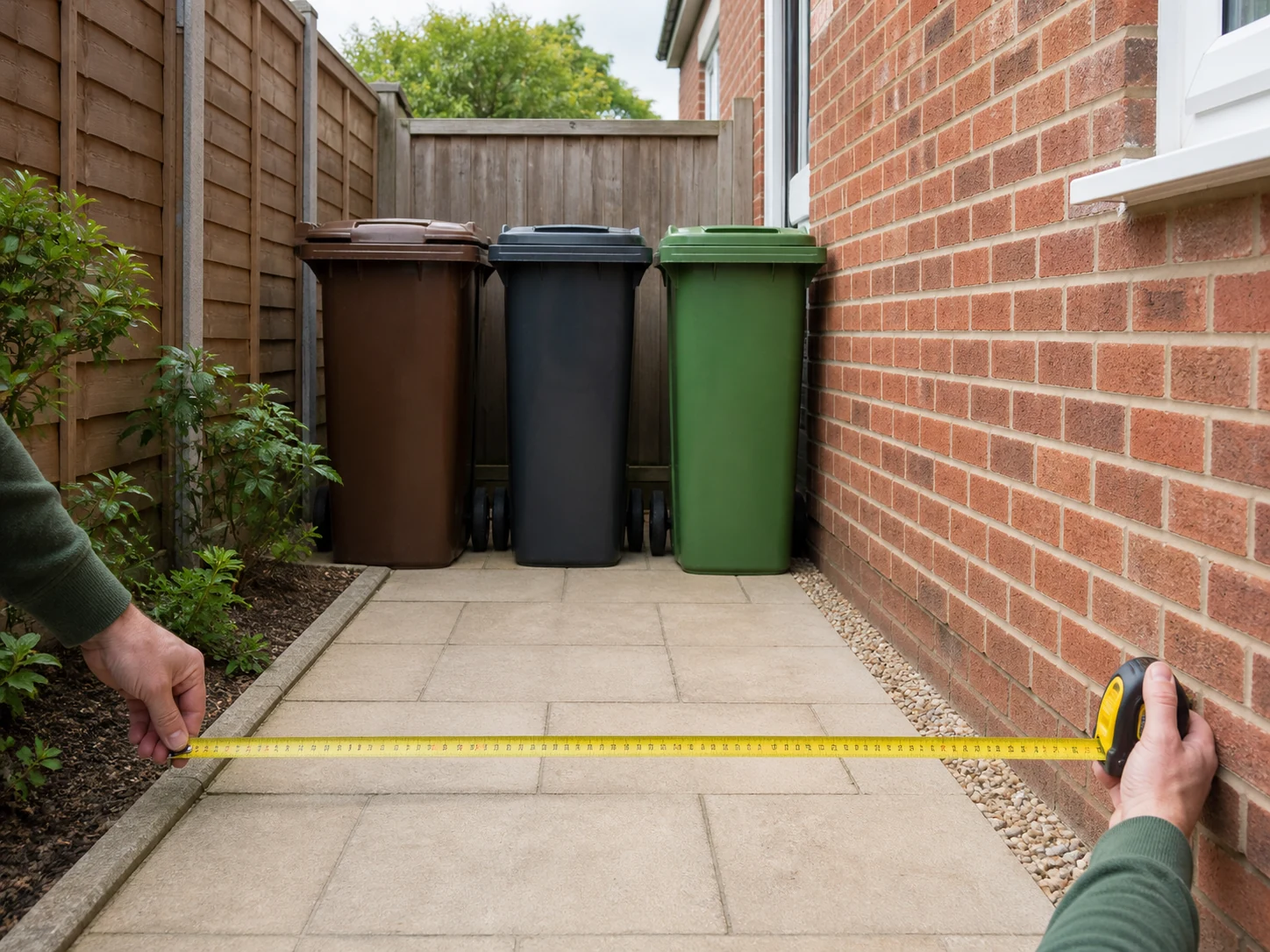
Measure these points
- Width: the widest point across the body, lid or handles.
- Depth: from the frontmost point to the rear wheels or handle.
- Height: from the ground to the highest point of the closed lid.
Why litre capacity is only a starting point
A litre figure describes how much a wheelie bin can hold; it is not a shared external-size standard. Councils and manufacturers use different body shapes, wheel housings, lids and handles. Two 240L bins can therefore need different amounts of floor space, and a replacement bin can stop fitting a store that was bought around the old one.
Allow room for real everyday use
A storage unit must do more than contain the closed bin. Leave practical clearance so the lid can open without striking the roof, the bin can roll over the threshold, and your hands can reach the handle. If the store has doors, check their open width and the clear space needed in front. A measurement that fits exactly on paper can still be awkward when the ground slopes or the wheels sit against a raised edge.
Measure every bin separately
Do not copy one set of measurements across a mixed collection. General waste, recycling and garden-waste bins may come from different suppliers even when they look similar. Measure each bin with its lid closed, then record the greatest width, depth and height. Repeat the height check with the lid fully open if the store has a fixed or low roof.
Check the installation area as carefully as the bins
- Usable width: measure between the narrowest fixed points, not wall to wall at the widest point.
- Usable depth: allow for pipes, downpipes, steps and handles that project behind the bin.
- Closed and open height: include roof supports and the arc of a lifting lid.
- Front clearance: make sure doors and bins can move without blocking a path or gate.
- Ground condition: check that the base is level, firm and suitable for the product’s fixing method.
Common UK capacities
120L and 140L bins are often used where collections or households are smaller; 180L and 240L bins are common household sizes; 360L bins are taller and wider and need a larger enclosure. These are useful shopping categories, but the exact manufacturer dimensions should decide whether a product fits. If a retailer omits an internal measurement, treat the match as unverified and ask for a drawing before ordering.
A sensible final check
Compare your measurements with the store’s internal dimensions, not only its advertised external size. Confirm door aperture, roof opening, threshold height and assembly tolerances. Keep a small margin wherever possible: it makes the store easier to use and gives you a better chance of accommodating a future replacement bin.
UK wheelie bin sizes: measure before you choose a store
Wheelie bins are commonly described by litres, but the outside size determines whether a bin store will fit beside a gate, path or wall. Measure your own bin at its widest, deepest and tallest point, including lid hinges and wheels. Councils and manufacturers use different moulds, so capacity is a guide rather than a replacement for a direct measurement.
Plan space around the bin, not just the bin itself
| Capacity | Typical use | Planning note |
|---|---|---|
| 120L to 140L | Smaller households and recycling | Check width carefully because body shapes vary. |
| 180L | Household or garden waste | Measure with the lid fully closed. |
| 240L | Common household bin | Allow depth to open the lid and roll it out. |
| 360L | Shared or commercial collections | Confirm turning space and access first. |
How to measure correctly
- Measure the widest point across lid and body.
- Measure front-to-back depth.
- Measure ground-to-lid height.
- Add clearance for wheels, doors, lid opening and a comfortable pull-out route.
For a double or triple store, leave practical space between bins so handles and lids stay easy to use. Compare layouts in our wheelie bin storage guide, then match published internal dimensions against your own measurements before ordering.
Quick answers
Are all 240L bins identical? No. Measure the actual bin. How much clearance is needed? Enough to open doors and lids safely and roll the bin out without scraping. Can you buy by litres alone? Use litres to shortlist, then confirm internal store dimensions.